The world of craft beer can feel overwhelming when you first step into a taproom and see a menu listing ten different styles you've never heard of. But understanding beer styles isn't about memorizing a textbook - it's about knowing what flavors to expect and finding what you actually enjoy drinking. Whether you're curious about the difference between an IPA and a stout, or you want to understand why some beers taste fruity while others taste roasted, this guide breaks down the essentials of craft beer styles and the flavors that define them.
The Building Blocks: Four Ingredients That Shape Every Beer
Every beer you've ever tasted comes down to four core ingredients: malt, hops, yeast, and water. The magic happens in how brewers combine and manipulate these elements.
Malted barley provides the foundation. When barley is malted, it's soaked, germinated, and dried, converting starches into fermentable sugars. Pale malts give you those light, bready, cracker-like notes you taste in pilsners and blonde ales. Roast the malt darker, and you start getting caramel sweetness in amber ales. Push it further, and you reach the coffee and chocolate flavors that define stouts and porters. A single beer might use five or six different malt varieties to build its flavor profile.
Hops balance that malt sweetness with bitterness, measured in International Bitterness Units (IBU). But hops do more than just add bitterness - they're responsible for the citrus punch in a West Coast IPA, the piney sharpness in a pale ale, the floral notes in a Czech pilsner, or the tropical mango and passionfruit character in a New England IPA. The same hop variety can express differently depending on when it's added during brewing.
Yeast might be the most underrated ingredient. It doesn't just convert sugar to alcohol - it creates flavor. We'll get into this more when we talk about ales versus lagers, but yeast is what gives Belgian beers their spicy, phenolic character and what creates the banana and clove notes in a hefeweizen.
💡 Pro Tip: When you're tasting a new beer, smell it first before you take a sip. Most of what we perceive as flavor is actually aroma. Swirl it gently in the glass, take a good sniff, and you'll pick up citrus, pine, caramel, or roasted notes that help you identify what malts and hops the brewer used.
Ales vs. Lagers: The Fundamental Split
Before diving into specific styles, you need to understand the basic divide in the beer world: ales and lagers. This isn't about flavor preference - it's about biology and temperature.
Ales use top-fermenting yeast strains that work at warmer temperatures, typically between 60-75°F. These warmer fermentation temperatures encourage yeast to produce more complex flavor compounds - esters that taste fruity, phenols that taste spicy, and other aromatic molecules. That's why ales tend to have more flavor complexity and a fuller, rounder mouthfeel. IPAs, stouts, porters, pale ales, wheat beers, and Belgian styles are all ales.
Lagers use bottom-fermenting yeast that prefers cooler temperatures, usually 45-55°F, and they require a longer, colder conditioning period called lagering. This slower, colder process produces cleaner, crisper beers with fewer fruity or spicy yeast characteristics. The malt and hop flavors come through more directly. Pilsners, helles, dunkels, bocks, and Mexican lagers all fall into this category.
Neither is better than the other. They're different tools for different flavor goals. When you want bright, clean, refreshing, a lager delivers. When you want bold, complex, aromatic, an ale is usually the answer.
💡 Pro Tip: If you normally drink lagers and find ales too heavy or intense, try starting with a blonde ale or kolsch. Both are technically ales but they're brewed to be light and crisp, bridging the gap between the two families without overwhelming your palate.
Common Styles and What They Actually Taste Like
Let's break down the styles you'll see most often at breweries and bottle shops, organized by what you'll experience when you drink them.
India Pale Ale (IPA) is probably the most recognized craft beer style. It originated in the United Kingdom, where brewers added extra hops to preserve beer during long voyages to India - that higher hop content acted as a natural preservative. Modern IPAs come in several sub-styles. West Coast IPAs are aggressively bitter with clear, pine and grapefruit hop character. New England or Hazy IPAs are juicy, soft, and loaded with tropical fruit flavors like mango and peach, with minimal bitterness despite the hop load. You'll typically see IBUs ranging from 40-70, though some push past 100.
Stouts and Porters sit on the darker end of the spectrum. Porters are medium-bodied with chocolate, toffee, and coffee notes from the roasted malt. Stouts take that roast character further - think espresso, dark chocolate, sometimes even a slight burnt or ashy note. Milk stouts add lactose (unfermentable sugar) for a sweeter, creamier body. Imperial stouts crank up the alcohol to 8-12% and deliver intense, almost dessert-like richness.
Wheat Beers include German hefeweizens and Belgian witbiers. Hefeweizens showcase yeast-driven flavors - banana, clove, sometimes bubblegum - with a soft, pillowy mouthfeel from the wheat. Witbiers are brewed with coriander and orange peel, giving them a bright, citrusy, slightly spicy character. Both are cloudy because they're unfiltered.
Sours have exploded in popularity. Gose is a German style brewed with salt and coriander, tart but refreshing. Berliner weisse is lighter and more acidic. American wild ales can incorporate fruit and barrel aging for complex, funky, wine-like flavors. The sourness comes from bacteria like lactobacillus, not from hops or malt.
Pilsners represent the lager side. Czech pilsners have a soft, bready malt backbone with earthy, spicy hop notes. German pilsners are crisper and more hop-forward but still clean. Both are sessionable, meaning you can drink several without palate fatigue.
How to Explore and Find Your Preferences
Understanding styles academically is one thing. Finding what you actually like to drink requires experimentation, and there's a smarter way to do it than randomly ordering beers.
Start by identifying one beer you already enjoy, then ask your bartender or beer shop staff for something similar but slightly different. If you like Blue Moon, try a traditional German hefeweizen to taste the style without the orange garnish. If you enjoy Guinness, try an oatmeal stout or a coffee porter to explore that roasted flavor territory.
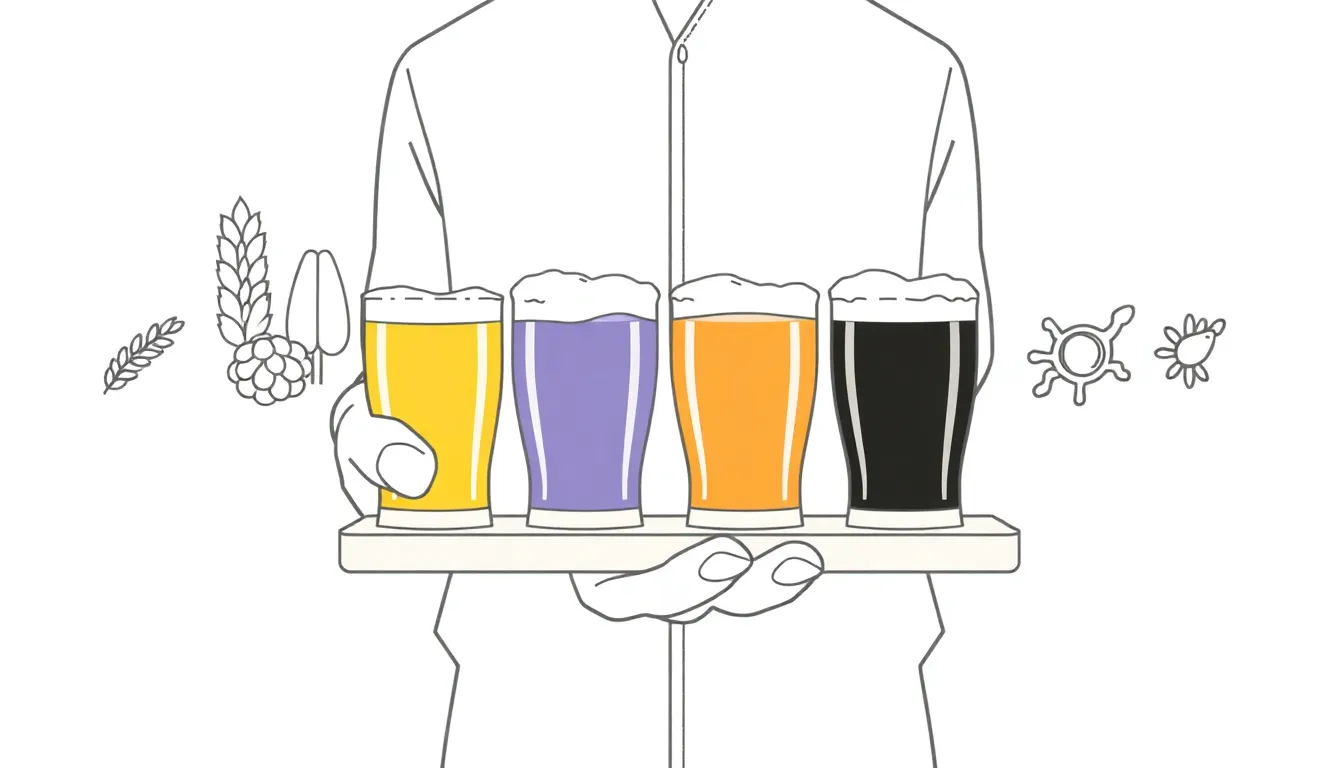
Most breweries offer flights - usually four 4-ounce pours for around $12-16 - specifically so you can sample across styles. Build your flight strategically: start with the lightest beer and move to the heaviest. Go pilsner, then pale ale, then IPA, then stout. Your palate adjusts to intensity, so if you start with a 90 IBU double IPA, everything else will taste like water.
Pay attention to what you're noticing. Do you like bitterness or does it turn you off? Do you prefer clean, crisp flavors or complex, fruity ones? Are you drawn to roasted, coffee-like notes or lighter, bread-like malt? These preferences will guide you toward certain styles and away from others, and that's completely fine. Nobody likes every style.
Don't skip lagers just because they seem boring compared to trendy hazy IPAs. A well-made pilsner or helles shows incredible craftsmanship precisely because there's nowhere to hide flaws behind bold hops or heavy malt. Some of the best breweries in the world are known for their lagers.
Conclusion
Craft beer styles aren't gatekeeping categories designed to make you feel ignorant - they're a practical language for describing what's in your glass and what you might want to try next. Once you understand that IPAs prioritize hops, stouts showcase roasted malt, lagers aim for clean crispness, and ales embrace complexity, you can navigate any beer menu with confidence. The goal isn't to become a certified cicerone who can identify every obscure substyle. It's to know enough about how malt, hops, yeast, and fermentation interact that you can order something you'll enjoy, explain to a bartender what you're looking for, and maybe discover a new favorite along the way. Taste widely, pay attention to what you're experiencing, and remember that the best beer is always the one you actually want to drink.
FAQs
What does IBU actually tell me about a beer?
IBU measures the concentration of bitter compounds from hops, but it doesn't tell the whole story. A beer with 60 IBU might taste more bitter than one with 80 IBU if it has less malt sweetness to balance the hops. Context matters - in a big, malty imperial stout, 60 IBU barely registers, but in a light pilsner, it would be overwhelming. Use IBU as a rough guide, but taste is what counts.
Why do some beers cost $8 for a single can while others are $12 for a six-pack?
Price often reflects ingredient cost and production complexity. Hazy IPAs require massive dry-hop additions - sometimes three pounds of hops per barrel - driving up costs to $3-4 per pound for premium varieties. Barrel-aged beers tie up fermentation space for months or years. Fruited sours might use hundreds of pounds of real fruit. Mass-produced lagers benefit from economy of scale that small-batch craft beers can't match.
How long can I store craft beer before it goes bad?
It depends entirely on style and alcohol content. Hoppy beers like IPAs lose their aromatic punch within 60-90 days - drink them fresh. High-alcohol beers like barleywines, imperial stouts, and Belgian strong ales can age for years, developing sherry-like, oxidized flavors that some people love. Standard pale ales, pilsners, and wheat beers are best within three to six months. Always check the canned-on or bottled-on date if the brewery prints one.
Do I really need specific glassware for different beer styles?
You don't need it, but it genuinely makes a difference for aromatic styles. A tulip glass or snifter concentrates the aroma of IPAs and Belgian ales so you smell them before you taste them. A tall, narrow pilsner glass showcases carbonation and maintains the head. A wide-mouthed goblet releases the complex esters in a tripel. For everyday drinking, any clean glass works - just avoid freezing your glassware, which kills aroma and can make beer taste watery.
What's the difference between craft beer and regular beer?
The Brewers Association defines a craft brewery based on size (under 6 million barrels annually), independence (less than 25% owned by non-craft), and traditional ingredients. But practically, craft beer emphasizes flavor diversity, traditional brewing methods, and local or regional identity. Mainstream lagers from large breweries prioritize consistency, wide appeal, and cost efficiency. Neither is wrong - they serve different purposes and different moments.